



Equipment
Instruments
Technology acquired under project PID2022-142147NB-I00 and routinely used at the Aquatics Lab for biomechanical, physiological and technical assessment of competitive swimming performance.
Sections 01–04 list equipment acquired specifically under the SWIM III project. Section 05 includes pre-existing Aquatics Lab instrumentation routinely used by the project.
Computing and processing
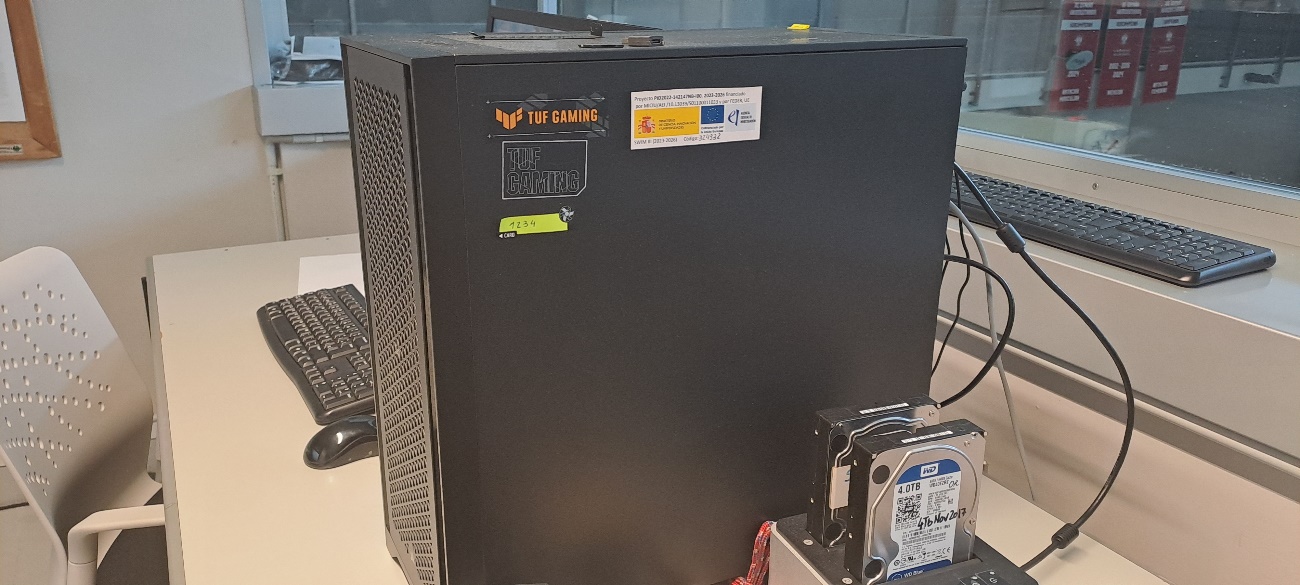
324332 · 16/04/2024
ASUS TUF Gaming — Intel Core / RTX 4070 workstation
TUF Gaming Tower with Intel Core processor, 4 TB storage and Nvidia GeForce RTX 4070 GPU (ASUSTeK Computer Inc., Taipei, Taiwan).
The ASUS TUF Gaming is the laboratory's main workstation for computer-vision inference and model training. Its multi-core Intel Core processor and Nvidia GeForce RTX 4070 with 12 GB of dedicated VRAM expose 5,888 CUDA cores and TensorRT compatibility, making it the central node for neural network workflows: automatic swimmer detection with YOLO-v8 models over the 8 cameras of the ASPA 2,584 × 1,632 px stitched panorama, segmentation of technical phases, reconstruction of the swim from surface-underwater synchronisation, and training of in-house load-velocity models. Beyond AI, the 4 TB Western Digital Blue storage for raw video datasets and NVMe SSDs for the system and processing cache support multi-track video editing (DaVinci Resolve, Adobe Premiere) without proxies, H.265 export of ASPA panels, biomechanical simulations in Kwon 3D XP and parallel statistical analysis in R, SPSS and MATLAB. The tower features reinforced air cooling and dust filters, a requirement in a laboratory environment with high humidity near the aquatic facilities. It is integrated into the Aquatics Lab internal network via 2.5 Gb/s Ethernet for the real-time camera cluster feed and the NAGI/Smart Pool system. Its quiet operation allows the technician to work in close proximity during long sessions without the acoustic fatigue typical of intensive computing stations.
Video systems
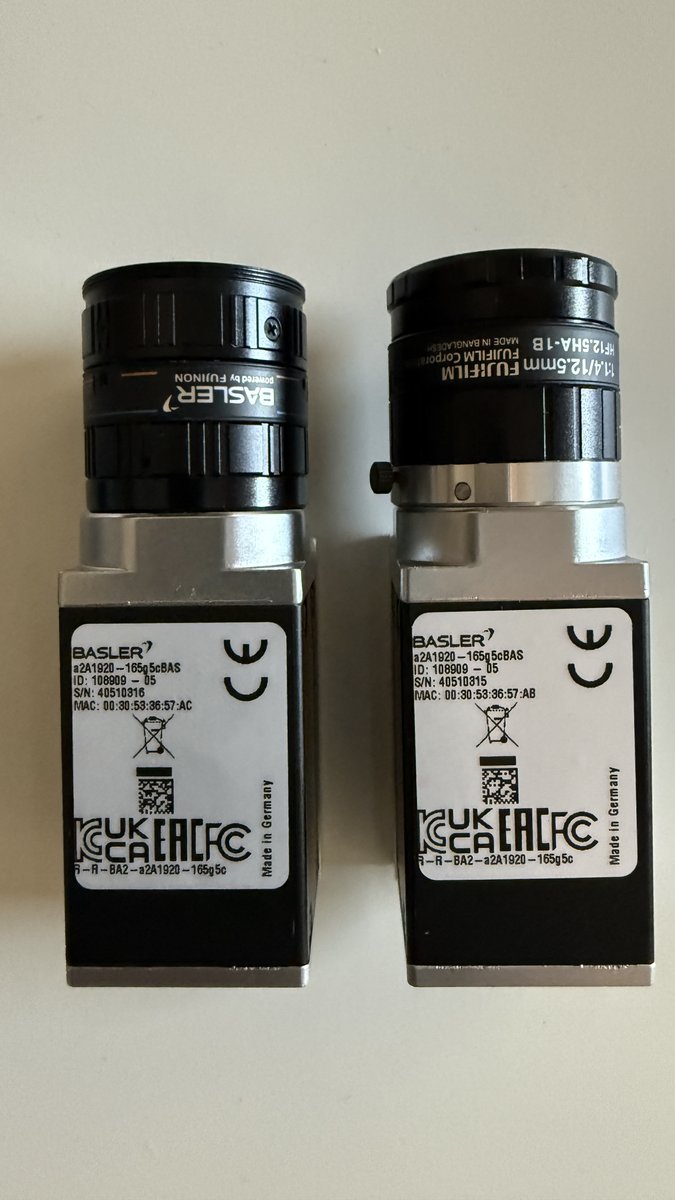
BASLER ACE 2 PRO · a2A1920-165g5cBAS
Basler ace 2 Pro — GigE Vision industrial cameras
ace 2 Pro a2A1920-165g5cBAS (Basler AG, Ahrensburg, Germany); Fujinon HF12.5HA-1B 12.5 mm f/1.4 lenses (Fujifilm Corporation, Tokyo, Japan).
Two Basler ace 2 Pro industrial cameras model a2A1920-165g5cBAS (S/N 40510315 and 40510316) integrated into the laboratory's multi-camera system. The Sony IMX392 BSI back-illuminated sensor captures images at 1920 × 1200 px (2.3 MP) with a maximum frame rate of 165 fps, 12-bit colour depth and Bayer pattern, allowing critical technical phases —hand entry, underwater undulation, turn, push-off— to be recorded with temporal resolution above the broadcast standard. The GigE Vision over PoE interface provides power and data over a single RJ45 cable up to 100 m, and IEEE 1588 (PTP) timing delivers sub-microsecond synchronisation between cameras —a critical factor for three-dimensional swim reconstruction. Each body mounts a Fujinon HF12.5HA-1B 12.5 mm fixed focal lens with f/1.4 aperture (C-mount), chosen for its distortion-free geometry to the edges and the field-of-view coverage required for a single lane at the working distance from the side pool windows. The two bodies are connected to the main RTX 4070 processing tower through a 4-port high-speed Ethernet card, ensuring the aggregate bandwidth needed to maintain a continuous feed without frame loss during long takes, and allowing future expansion of the camera cluster.
Measurement, assessment and training systems
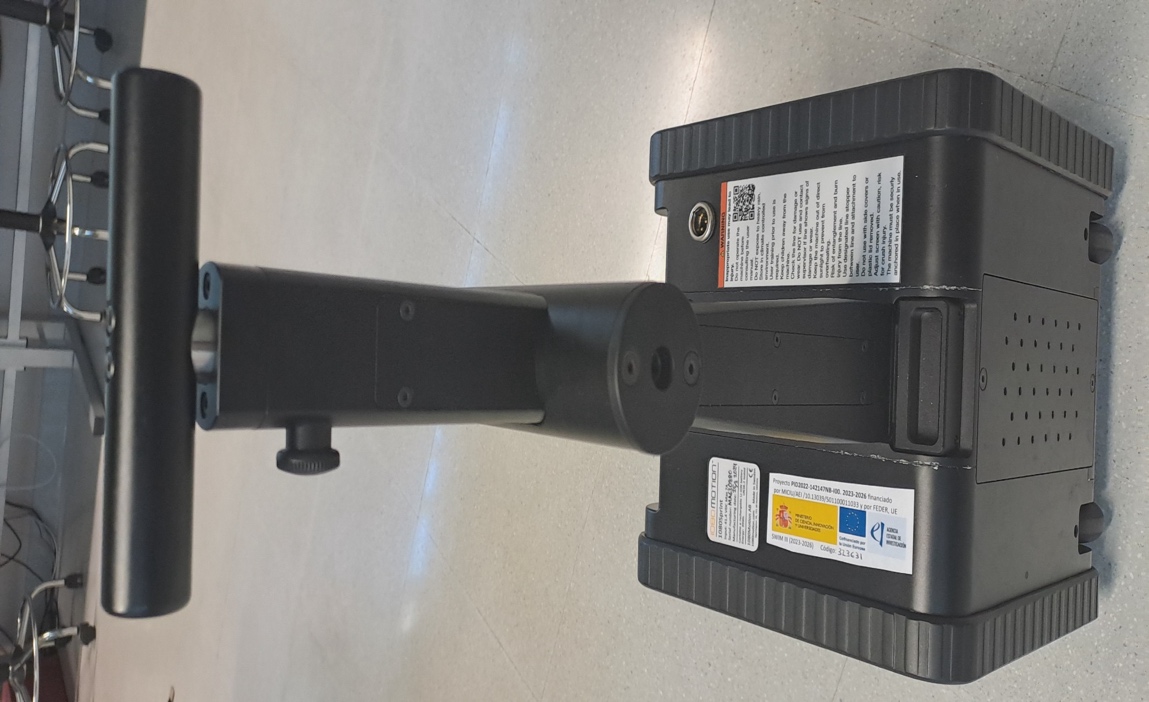
323631 · 28/02/2024
1080 Sprint 2 — Main assessment system
1080 Sprint 2 (1080 Motion AB, Stockholm, Sweden).
The 1080 Sprint 2 is the main assessment tool for swimmer mechanical performance at the Aquatics Lab. Its servo-motor drum generates a constant and individually programmable resistance between 0 and 50 kg with controlled return, enabling progressive loads in 5–10 m pulls at the poolside or in dry sprints. Each pull returns in real time peak velocity, mean velocity, mean force, mean power and total work, with a sampling frequency of 333 Hz. From the full session the software computes the individual load-velocity (L-V) profile (L0, v0, Aline) and the optimal velocity for maximum power application, a key variable in the project publications on sprint performance in short and long course pools. The unit incorporates an adjustable tripod, reinforced Kevlar cable and adjustable harness for adult/junior swimmers. Synchronisation with the ASPA system and the ALGE timing system allows alignment of the measured segment with the technical phase observed on video. It is used both in periodic assessment sessions —to detect sprint capacity losses during training cessation— and in experimental studies on the effect of specific warm-up (PAPE), post-static-stretching potentiation, or the transfer of eccentric pulley training to actual in-water displacement. It is the reference device for all load-velocity measurements reported in the project publications.
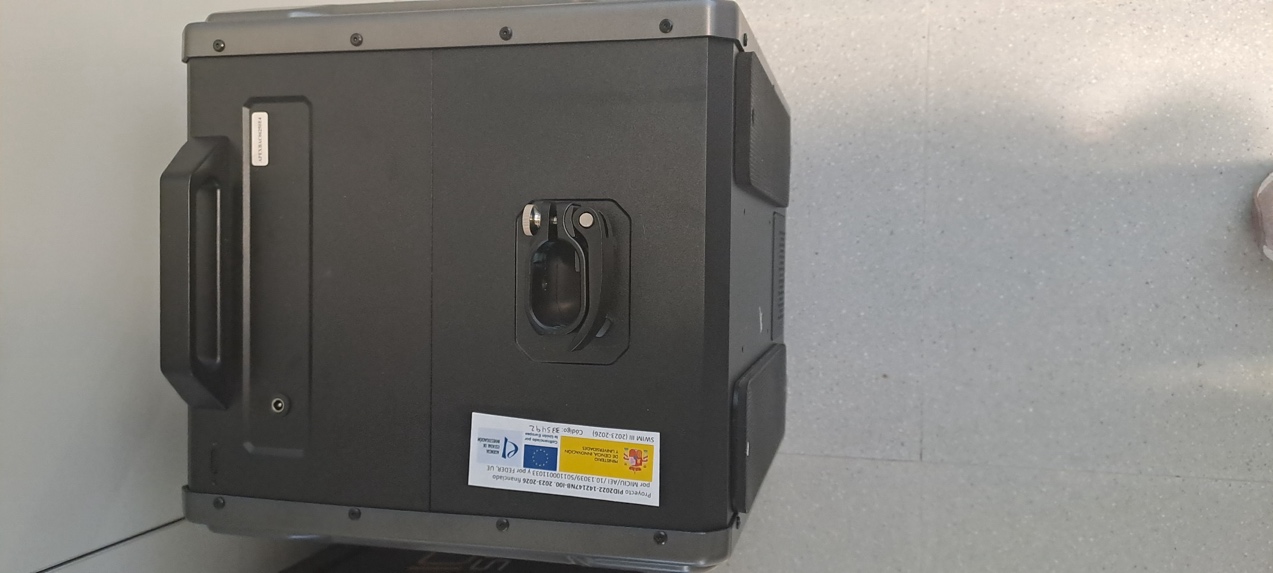
335492 · 21/11/2025
T-APEX — Main assisted and resisted swim training system
T-APEX (Hong Kong).
The T-APEX is the main tool for assisted and resisted swim training at the Aquatics Lab. Housed in a reinforced flight case for deployment at the poolside, it integrates an electronically controlled resistance/assistance motor that applies a programmable force to the swimmer via Kevlar cable and harness throughout the full pool length. In resisted mode, the swimmer moves a constant or incremental load that multiplies the propulsive effort relative to free swimming, generating a specific overload stimulus on the motor pattern. In assisted mode, the motor pulls the swimmer at a speed higher than they would reach on their own, briefly exposing them to a supramaximal velocity (overspeed) — a useful setting for the central nervous system to assimilate technical patterns at stroke rates that are not accessible in free swimming. In both modes the system records velocity, applied force and power in real time, allowing the training dose to be quantified without relying on the coach's subjective appraisal. In the SWIM III project it is used to induce and verify post-activation performance enhancement (PAPE) responses in specific warm-ups, to study the mechanical transfer from dry-land strength work to the aquatic environment, and to design microcycles of selective overload on the critical segments of competition. The wireless tablet connection delivers immediate visual feedback to the swimmer and coach between sets.
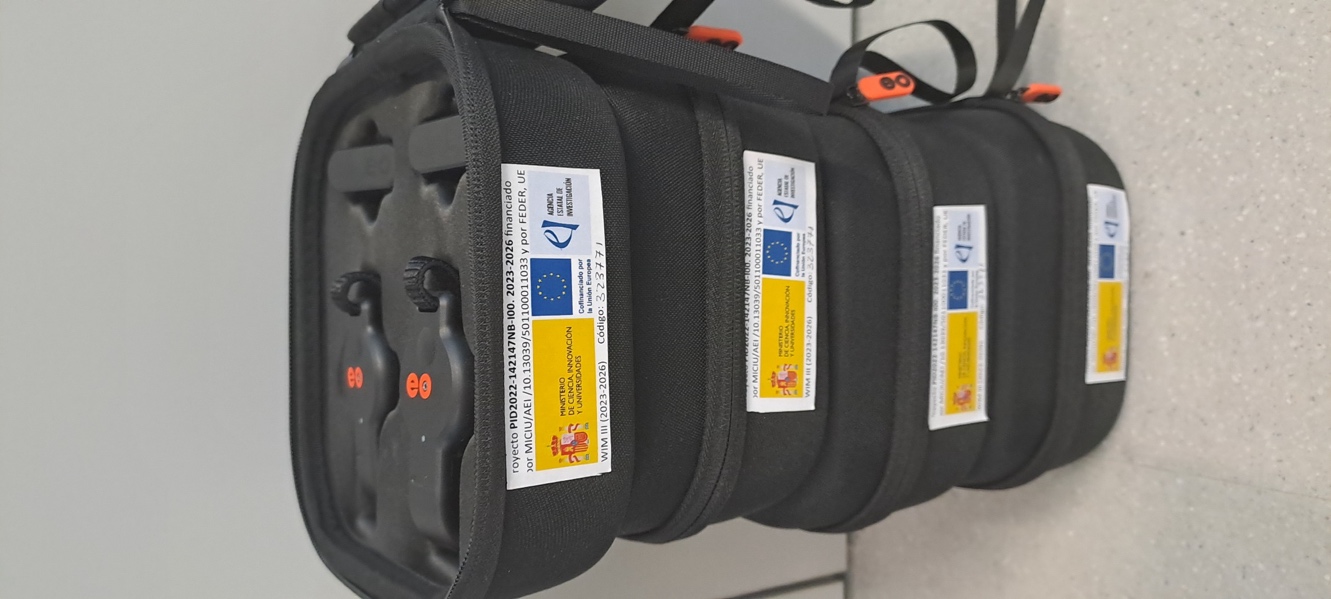
323771 · 27/02/2024
SwimBetter EO — Palm-pressure meter
SwimBetter EO (SwimBetter, Stockholm, Sweden).
The SwimBetter EO is a glove system with integrated pressure sensors that quantifies the force applied per stroke in any swimming style. Each glove incorporates a set of piezoelectric transducers distributed across the palm of the hand that record the pressure distribution in real time during the propulsive phase, with low-latency Bluetooth transmission to the SwimBetter app on a poolside tablet. For every stroke the system returns the peak force, stroke impulse, force/time ratio and left-right symmetry, together with the full temporal trajectory of the pressure profile. It enables quantification of actual mechanical output in the water without obstructive instrumentation, one of the long-standing limitations of biomechanical analysis in competitive swimming. The laboratory uses it for three types of assessment: (1) individual characterisation of the swimmer's propulsive pattern and detection of technical asymmetries; (2) longitudinal monitoring of the response to specific strength training (palm-press, weighted pull-ups, eccentric exercises on conical pulley); and (3) experimental studies on the effect of PAPE warm-up on stroke force generation immediately after the conditioning stimulus. Pre-session calibration and temporal synchronisation with the ASPA system ensure traceability of each stroke series with the technical phase observed in underwater video.
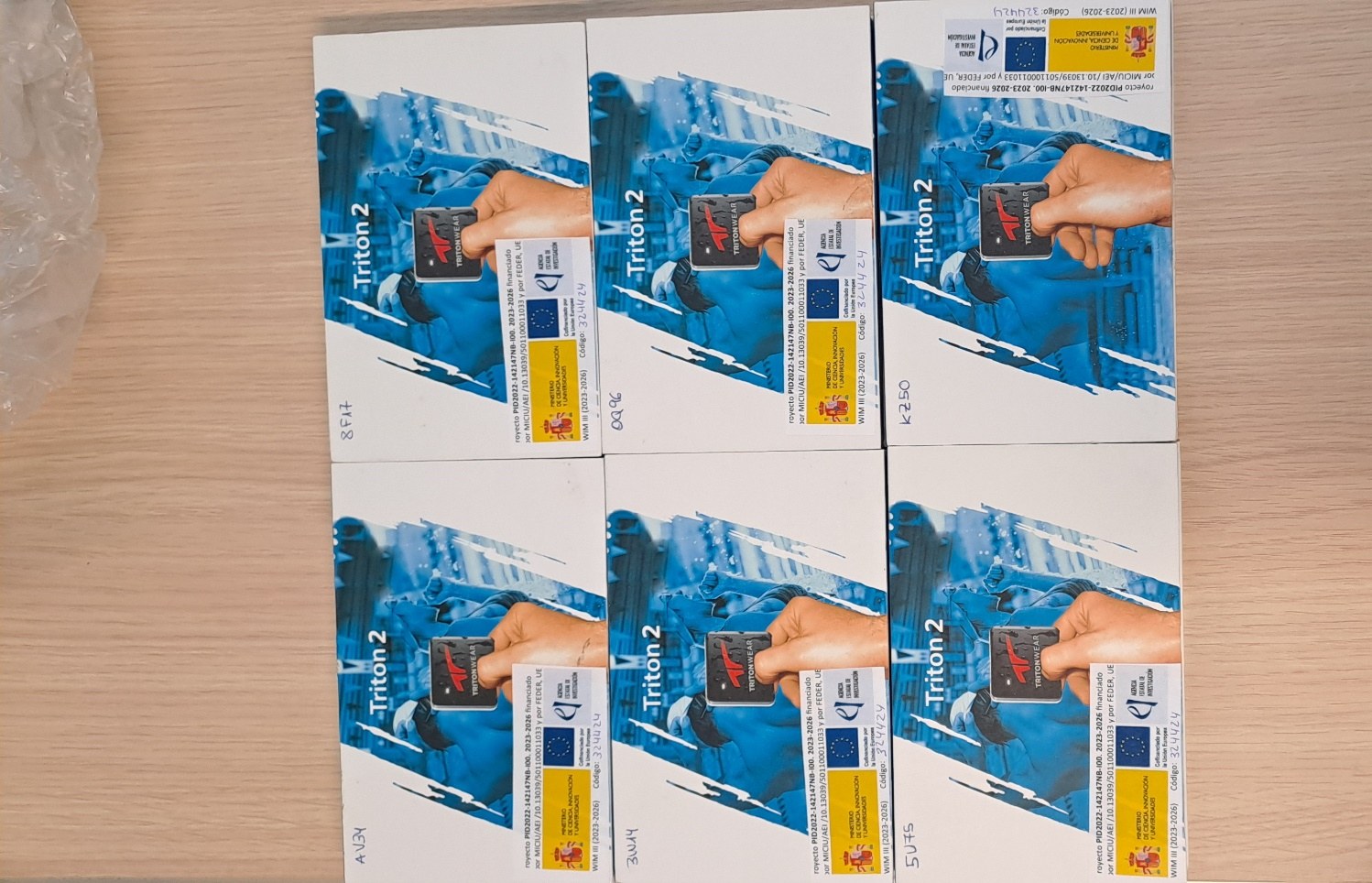
324424 · 19/04/2024
TritonWear Tritón 2 — Swimming tracking system
Tritón 2 (TritonWear Inc., Toronto, Canada).
The TritonWear Tritón 2 is a set of wearable devices for automatic tracking of technical variables during swimming training. Each unit integrates a three-axis accelerometer, gyroscope and barometer with internal storage; it is fixed to the swimmer's cap and reconstructs, throughout the session, the fundamental set of swimming variables: distance covered, number of lengths, time per length, stroke rate, stroke length, stroke index, number of strokes per length and turn time. After the session, data are downloaded wirelessly to the coach app, where they are grouped by training block, stroke and intensity. The laboratory has several units, allowing simultaneous instrumentation of a full training group (8 lanes × 4 swimmers) without disrupting the usual session flow. Compared with manual coach observation or post-hoc video analysis, the Tritón 2 offers an autonomous, non-invasive and traceable alternative for building longitudinal training load databases. In the SWIM III project it is used to verify technical consistency between sessions, detect early deviations in stroke rate/length that may anticipate accumulated fatigue, and characterise swimmer response during tapering weeks before reference competitions.
Display and documentation

324538 · 23/04/2024
Samsung TQ50LS03BG — Analysis room screen
"The Frame" series 50" QLED screen TQ50LS03BG (Samsung Electronics, Seoul, South Korea).
The Samsung TQ50LS03BG is the main screen in the analysis room. It features a QLED panel with 100 % DCI-P3 colour volume, HDR10+ capability and a matte antiglare finish specifically designed for working environments with significant ambient light. It is used as a review and post-session analysis monitor: synchronised display of ASPA video streams during 100 m freestyle and other criterion tests, simultaneous reproduction of overhead and underwater views, observation of technical feedback after each set, and projection of the result panels produced by the in-house software (per-segment velocity graphs, 5 m splits, stroke rate and length). The four HDMI inputs allow switching between the RTX 4070 processing tower, the coach laptop, the PTZ robotic camera and the NAGI output without cabling reorganisation. D65 colour calibration and 60 Hz refresh rate ensure that the subtle chromatic variations of the colour-coded APA analysis are faithfully reproduced on the dark laboratory background. Its "Art Mode" doubles as institutional signage support —UGR, Aquatics Lab, AEI logos— when the laboratory hosts external visits, federations or evaluators, while keeping power consumption minimal. AirPlay synchronisation from the field iPad avoids equipment movement between poolside and control room.

324538 · 23/04/2024
Samsung TQ50LS03BGU — Control room screen
"The Frame" series 50" QLED screen TQ50LS03BGU (Samsung Electronics, Seoul, South Korea).
The Samsung TQ50LS03BGU is the second QLED screen unit, located in the control room close to the poolside, where live measurement sessions are run. Unlike its twin in the analysis room, this unit operates in "real-time multi-view" mode: it is split into four quadrants showing simultaneously the processed ASPA system image (stitched 8-camera panorama 2,584 × 1,632 px), the PTZ robotic camera feed following the swimmer from the technical grandstand, the live physical data from the 1080 Sprint 2 or T-APEX, and the ALGE-Timing Racing Panels timing signal. This configuration enables the researcher to instantly detect technical anomalies, camera-synchronisation errors or swimmer fatigue signs, and to intervene before losing the next test segment. The screen incorporates dual-channel display: the capture technician sees the raw streams, while the on-site coach views the clean version with split-time overlay. Its antiglare panel is decisive in a room with a window directly facing the starting area, where natural light varies throughout the day. HDMI connectivity and optical input allow underwater camera audio to be redirected to the room speakers, easing coordination between technician, coach and swimmer without acoustic clarity loss.
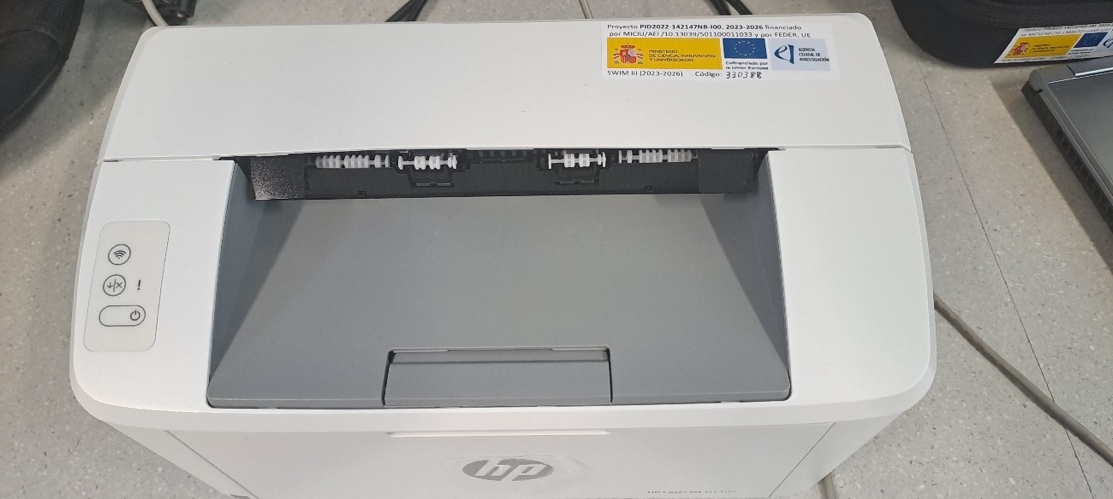
330388 · 11/03/2025
HP LaserJet M110W — Laser printer
LaserJet M110W (HP Inc., Palo Alto, California, USA).
The HP LaserJet M110W is a compact monochrome laser printer with Wi-Fi wireless connectivity, 20 ppm speed and 600 × 600 dpi resolution. At the Aquatics Lab it is used for routine production of experimental documentation: informed consent forms compliant with GDPR prior to each session with swimmers, PAR-Q follow-up questionnaires and rating of perceived exertion (RPE) scales, daily measurement protocols with a check-list of variables, individual load-velocity record sheets handed to the coach at session closure, administrative labels with the PID2022-142147NB-I00 code for material inventoried under AEI justification and voluntary participation certificates for swimmers and federations. Its small footprint (35 × 21 × 16 cm) fits discreetly into the control room without interfering with measurement equipment. Wi-Fi connection allows printing from the field researcher's laptop and from Android/iOS devices associated with the laboratory via HP Smart, with no need for cabling between poolside and dry-land room. The high-yield HP 150A toner supports long cycles without replacement, a relevant factor during intensive data-collection campaigns prior to reference competitions (Spanish Championship, World Junior, selection trials). It is a modest but essential support device: any experimental assessment campaign requires signed and traceable documentation justifying both ethical and financial conformity of the project before the AEI and the University of Granada.
Laboratory instrumentation
Pre-existing Aquatics Lab equipment that the SWIM III project routinely uses as supporting infrastructure. Publications derived from the project reference this instrumentation when it is the source of the reported measurements.
ASPA SYSTEM · 8 CAMERAS · 25 M · MAIN POOL
ASPA System — Automatic Swimming Performance Analysis
ASPA System: Basler avA1000-100gc industrial cameras (Basler AG, Ahrensburg, Germany); capture workstation Intel Core i7-5930K, 32 GB RAM, Nvidia RTX 4070 GPU, Windows 8.1 Pro; Mitsubishi MELSEC FX3G trigger PLC (Mitsubishi Electric Corporation, Tokyo, Japan). In-house software in Python 3.11 + OpenCV 4.10 + pypylon 2.2.1.
The ASPA System (Automatic Swimming Performance Analysis) is the main acquisition and technical analysis infrastructure installed over the 25 m main pool of the Aquatics Lab. It is the legacy tool inherited from the SWIM I and SWIM II projects, which SWIM III has modernised and keeps in production.
Camera cluster. Eight Basler avA1000-100gc industrial cameras with monochrome / Bayer GB8 colour sensor capture at 740 × 740 px per camera and 83.33 Hz (competition mode) or 50 Hz (training mode). The eight images are stitched into a 2,584 × 1,632 px panorama that covers the entire pool with corrected overhead perspective. Image capture is raw Bayer with no prior BGR conversion, in order to preserve bit-by-bit compatibility with the legacy processing chain.
Synchronised trigger. An industrial Mitsubishi MELSEC FX3G PLC generates the common trigger signal for all cameras, ensuring that the eight frames stitched at each instant correspond strictly to the same physical moment, a critical requirement for the panoramic reconstruction not to introduce temporal distortion in the 5 m splits.
Network connectivity. The topology is point-to-point GigE without a switch, organised over two four-port NICs. NIC 1 (sockets 03–06) serves cameras CAM01–CAM04 in the 192.168.10–40.x range; NIC 2 (sockets 07–10) serves cameras CAM05–CAM08 in the 192.168.50–80.x range. This aggregated architecture provides the per-camera dedicated bandwidth that the 83.33 Hz feed requires and eliminates the collisions that a conventional switch would introduce in a synchronous capture.
WS-Piscina capture workstation. Intel Core i7-5930K processor with six cores and twelve threads, 32 GB of RAM, Nvidia RTX 4070 GPU and Windows 8.1 Pro operating system. The i7-5930K was selected for its compatibility with the legacy SWIM I chain; the RTX 4070 added under SWIM III enables near real-time YOLO inference. Capture writes raw Bayer BMP to disk, with the panorama encoded to H.265 video in a second offline pass, as real-time encoding at 2,584 × 1,632 is not feasible on this processor.
In-house software stack. The stack has been rewritten under SWIM III on Python 3.11 + OpenCV 4.10 + Basler pypylon 2.2.1, replacing the legacy FAICONATACION.exe binary (C# / .NET / OpenCV 2.4.10) inherited without source code. The GUI applications are four: aspa_gui for synchronised eight-camera capture; aspa_8_cam_control_gui for ROI, exposure and gain tuning with .pfs profile writing; aspa_exporter_qt for panorama stitching and H.265 encoding with overlaid lane lines; and aspa_analyzer_qt for analysis (YOLO detection, tracking, 5 m splits, stroke-rate FFT, emersion detection). The whole chain has been validated against the Gold Standard of the 2017 competitions with mean absolute error below 0.15 s.